In-Person Dating Is Back: Why Singles Nights Are Replacing Dating Apps
For fifteen years, meeting someone new meant downloading an app. That era is ending, and it is ending in the numbers, not just in the mood music. People are deleting the apps and going out instead. The question for anyone who runs a venue or an events business is what they go out to.
The dating app decline is real, and it is measurable
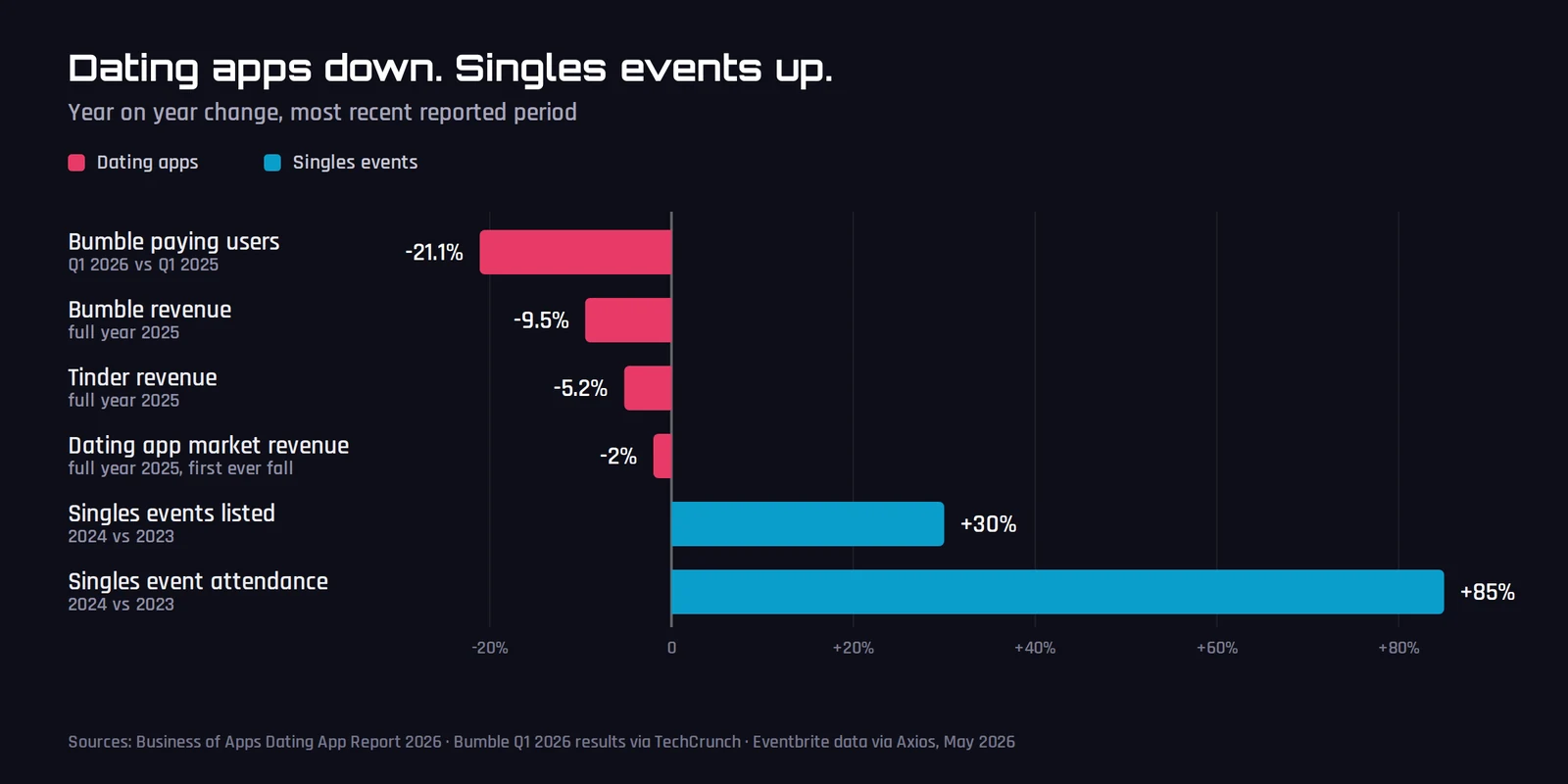
In 2025 the global dating app market recorded its first ever annual revenue decline, falling roughly 2% to $6 billion, with the pullback concentrated in North America and Europe. Tinder's revenue fell 5.2% and Bumble's fell 9.5% over the same period (Business of Apps, Dating App Report 2026).
The trend accelerated into 2026. Bumble reported that paying users fell 21.1% year on year in the first quarter of 2026, down to 3.2 million from 4 million, with revenue down 14.1% (TechCrunch, May 2026). Those are not the numbers of a category having a wobble. They are the numbers of a behaviour changing.
And the money is going somewhere. Singles events listed on Eventbrite doubled between 2022 and 2025. The steepest year was 2024, with a 30% rise in the number of events and an 85% jump in attendance (Axios, May 2026). People have not stopped wanting to meet each other. They have stopped wanting to do it through a screen.
Why people are walking away from the apps
Ask anyone who has quit and you get the same three answers.
It became work. Swiping, matching, opening, keeping a conversation alive with someone you have never met, and doing all of it across four apps at once. It stopped feeling like a social life and started feeling like an inbox.
It rarely ended in a meeting. "Not looking for a pen pal" became a standard line in profiles for a reason. Endless messaging that never converts into a coffee is the single most common complaint, and it is the one thing an evening out solves by definition.
The first thirty seconds were always awful anyway. Even when a date happened, two strangers met cold in a bar with nothing to do but assess each other. That is an interview, not an evening.
Speed dating solved the wrong problem
The obvious answer to app fatigue is speed dating, and it is having a genuine revival. But speed dating fixes the volume problem while making the awkwardness problem worse. Four minutes across a table, a bell, then do it again nineteen times. It is efficient and it is exhausting, and it asks the shyest person in the room to be at their most charming, on demand, forty times in a night.
Anyone who has hosted one knows the tell: the room is loudest in the ten minutes after the format ends, when people finally relax and talk to whoever is nearest.
This is a wellbeing story, not only a dating story
The government's Community and Engagement Survey for 2025/26, drawn from more than 175,000 responses in England, found 7% of adults feel lonely often or always. The rate is highest among the young: 9% of 16 to 24 year olds and 8% of 25 to 34 year olds, against 4% of those aged 65 to 74 (GOV.UK, 2026). Loneliness has sat at that level for two years, up from 5 to 6% a decade ago.
Read that alongside the app numbers and the picture is clear enough. The generation with the most sophisticated tools for meeting people ever built is the generation reporting the least connection. The tools were never the problem to solve. Being in a room with other people is.
Which is why the interesting opportunity is not "a better dating app". It is a better night out.
What is Let's Go Meet?
Let's Go Meet is a social event format built on top of Let's Go Games: an evening of live, interactive games where the games themselves do the introducing.
Nobody sits across a table being interviewed. Everyone plays. You are on a team with four people you have never met, working out a quiz answer together. You are paired with number 14 for ninety seconds with a question on the big screen to get you started. You are shouting at a horse race with the whole room. By the time the evening is halfway through you have spoken to twenty people without once having to walk up to a stranger and start a conversation from nothing.
Then, quietly and privately on your own phone, you pick the people you would like to meet again. So does everyone else. Where two people pick each other, the platform introduces them afterwards. Nobody is told they were not picked. Nobody ever finds out who picked them and did not get picked back.
We have looked, and we have not found another platform that does all of it in one place: the registration, the room, the games, the mingling, the matching and the introduction. Event companies have the rooms but no software. The apps have the software but no rooms. Let's Go Meet is both halves, and we believe that combination is a first.
How a Let's Go Meet night actually runs
Six beats, and the guest's phone is the only thing they need to bring.
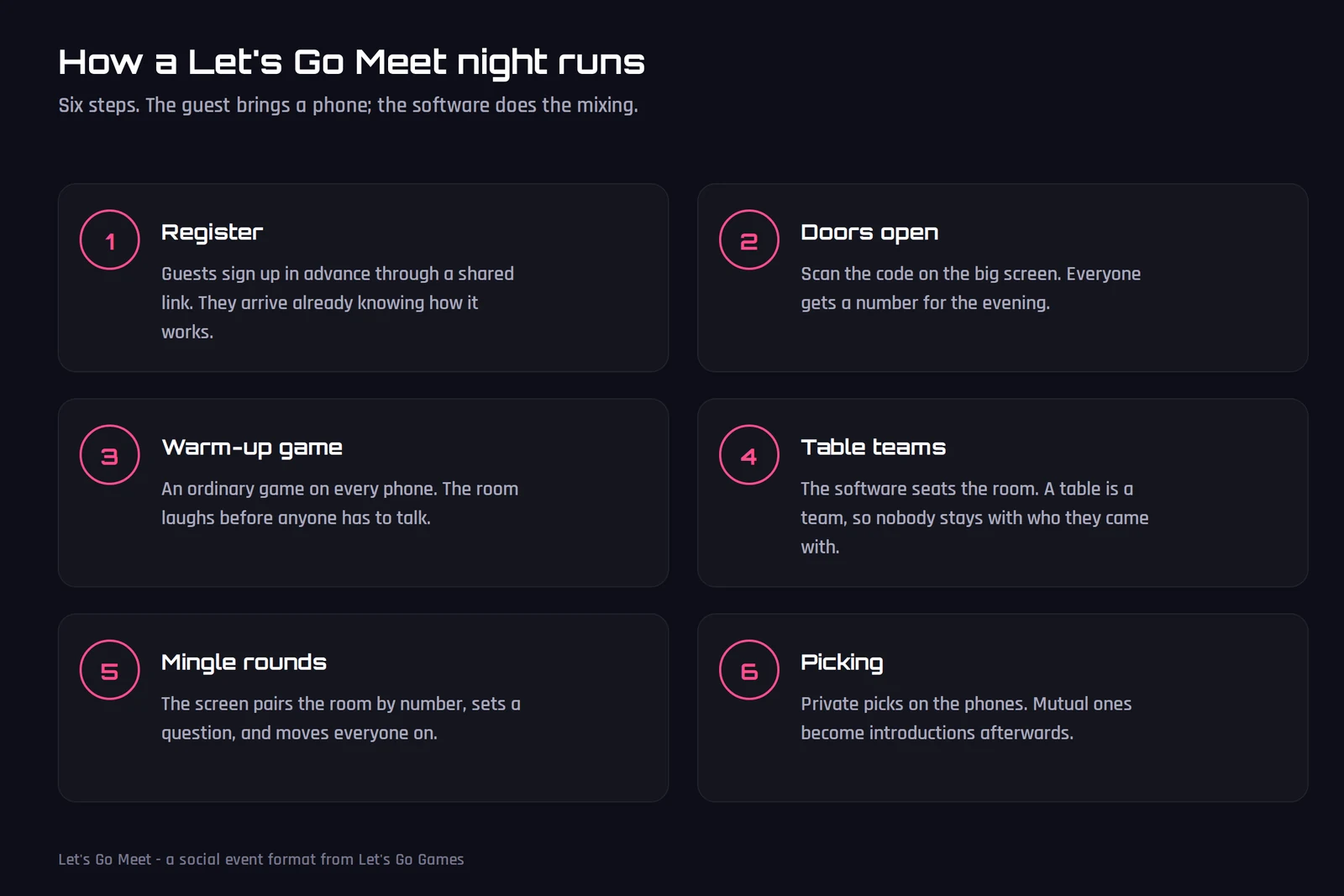
1. Registration, before the night. The host shares a link. Guests register in advance with a first name, an age band and a few interests. They arrive already knowing what the software looks like, because they have already used it. That alone kills the most awkward moment of any singles night.
2. Doors open. Guests scan the code on the big screen and are checked in. Everyone gets a number for the night. Numbers, not names, are how the room refers to each other, which is easier to shout across a noisy bar and more private by default.
3. A warm-up game. An ordinary game, played on everyone's phone, to get the room laughing before anyone has to talk to anyone. Music Bingo works beautifully here because the whole room sings.
4. Table teams. The software seats the room, and a table is a team. Nobody stays with the people they walked in with. The big screen shows where to sit, and every phone shows who else is on that table.
5. Mingle rounds. Between games, the screen pairs the room by number, gives each pair a question, and moves everyone on after ninety seconds. All the rotation of speed dating, none of the interview.
6. Picking, and then matches. Picking opens on the phones near the end. Everyone gets a small, fixed number of picks, so choosing means something. The big screen shows one thing at the end of the night: how many matches were made. Not who. Then the introductions go out privately afterwards.
Why games work better than small talk
There is a reason this works, and it is not complicated. A shared task removes the pressure of being interesting. When two people are trying to remember which Bananarama song that was, they are not performing for each other, and that is exactly when people are at their most likeable.
Games also do the rotation for you. The most common failure of any social event is that people arrive in twos and threes and leave in the same twos and threes. A running order that reshuffles teams and pairs the room on a timer makes mixing the default rather than something the brave do.
And a game gives everyone a role. In a room of strangers there is always someone who does not know what to do with their hands. Hand them a bingo card and that problem disappears.
Designed so nobody gets hurt
A format like this lives or dies on how it handles rejection and privacy, so those decisions were made first, not last.
- Mutual only. A match needs both people to pick each other. Nobody is ever told who picked them.
- No public rejection. No counts are shown to anyone, and no phone ever displays "you were not matched". Results arrive later, privately, and only when there is good news.
- The big screen never shows a name. The reveal is a number: how many matches the room made. That is the celebration, with nobody exposed.
- No phone numbers change hands. The platform brokers the introduction. If two matched people want to swap numbers, they do that themselves, in their own time.
- Report and block on every phone, one tap, working during and after the event, and a blocked pair is never matched at a future event either.
- Check-in is the gate. A code shared in a group chat is not enough to take part. You have to actually be in the room.
It is not only for singles
The same format runs three ways, and the second is bigger than the first.
Singles nights are the obvious one. Solos and newcomers is the larger and lower-pressure market: people who have moved to a new city, come out of a long relationship, retired, or simply want a social life that does not depend on already having one. Same software, different language. Nobody is dating; everyone is meeting people. And corporate mixers use the identical machinery for a new-starter cohort or a conference where nobody knows anybody, with the picking layer switched off entirely.
Become a Let's Go Meet host
We are running Let's Go Meet ourselves, as its own platform, and we are building a network of hosts to run events under it across the UK and internationally.
It suits people who already have the room and the audience: pub and bar operators with a quiet midweek, events companies looking for a format with a repeat audience, community organisers, and anyone already running singles or social nights who is tired of doing the matching by hand at one in the morning with a stack of paper slips.
What you bring is a venue and a room. What you get is a night that runs itself, guests who arrive already registered, and the matching handled for you.
If that sounds like something you would run, get in touch and we will talk you through how it works and what being part of the network involves.
Run Let's Go Meet events
We are building a network of hosts to run Let's Go Meet nights across the UK and internationally. If you have a venue, run events, or organise for a community and this sounds like your kind of evening, get in touch and we will talk you through how it works.
Get in Touch About HostingSee upcoming nights · See what the platform looks like · Book a live demo